
1. What about burning local fat?
Burning fat locally is not possible without the aid of surgery! During a weight loss attempt, the body taps into fat deposits distributed throughout the body. Body proportions will remain approximately the same. Every body has its own preference for the location of reserves of calories. In women, these are often the hips and waist; in men, the abdomen. Abdominal fat is accessed more quickly than, for example, hip fat. This can be achieved through both (endurance) training and by limiting your power supply ingested. Think especially of products you consume because they taste good, e.g., alcohol, soft drinks, sugar, refined carbohydrates, candy, and snacks. It is possible, however, to train the muscles in specific areas so that the body looks tighter and better-proportioned. We call this shaping. Strength training of specific parts of the body, such as the buttocks, legs, back, chest, and shoulders, is recommended. This can very doing good through the large movements to train exercises such as; squats, deadlifts, rows, bench press, lunges, etc.
2. Do you get fatter from the food you eat after 8:00 PM?
It is often thought that eating after 8:00 PM leads to weight gain, but that is not necessarily the case. Food products do not suddenly have more calories after 8:00 PM. It is about the amount of energy you have consumed throughout the day in relation to the energy you expend. There is, however, some difference in how fast the metabolism works during the day and at night. These differences are not so significant that they need to be taken into account; therefore, you will not gain 10 kilos because of this. If you exercise in the evening, it is actually wise to eat something afterwards to replenish glycogen stores in the muscles and enable muscle mass growth. It is important, however, to choose a healthy snack such as fruit.
3. Does drinking alcohol make you fatter?
No! Alcohol only contains over seven (7.1) calories per gram and it is an appetite stimulant. And because you drink it, you quickly consume a lot of calories. In addition, excessive alcohol consumption is harmful to our bodies, particularly to the liver and the brain. A glass or small shot of alcoholic beverage contains about 85 calories. That is the same as a thick slice of bread, but much less healthy! Especially in combination with food such as (fatty) snacks, alcohol consumption can contribute to overweight. Alcohol therefore provides a lot of calories quickly, but does not give a feeling of satiety. Consequently, it often doesn't stop at just one drink, and that, combined with heavy snacking, causes your calorie intake to skyrocket. Less alcohol is therefore better for both your energy balance and your health.
4. Does the speed of eating affect the feeling of satiety?
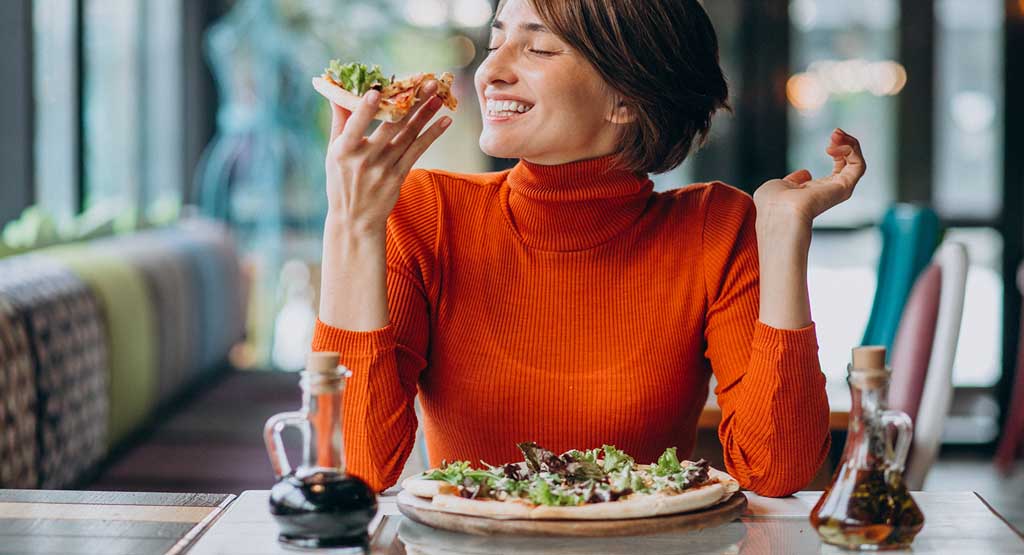
Eating something quickly can be very detrimental to your body weight. You often don't notice when you are full. The feeling of satiety only sets in after 20 minutes. A fast eater may therefore realize after 20 minutes that they have eaten too much, because the food is consumed so quickly. In addition, chewing food thoroughly is very important. The digestion of nutrients begins in the mouth. The stomach and intestines cannot properly digest poorly chewed food, which can result in constipation and reduced nutrient absorption. Moreover, by gulping down food, you swallow air, which causes bloating and flatulence. Eating slowly, chewing well, stopping eating on time, and listening carefully to your body is therefore the best advice.
Assignment:
Set a kitchen timer for 20 minutes while eating your hot meal and try to use that time to finish your plate slowly. Chew each bite at least 10 to 15 times. Then, after a week, see if this affects your feeling of fullness.
Do you need help with this?
Our nutritionists are happy to help you too!


 English
  Dutch
Dutch