
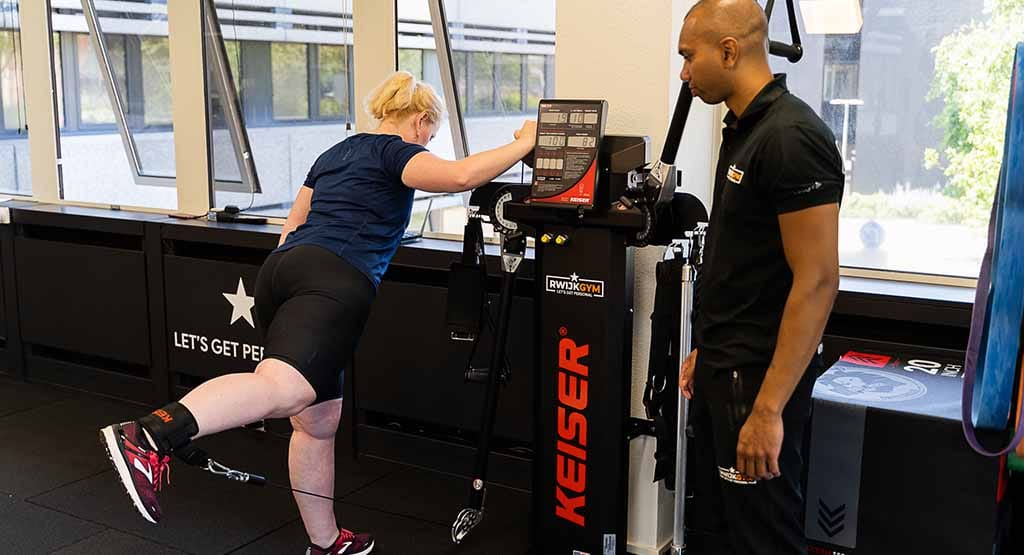
Every year, leading up to the New Year, we see that many people make it a New Year's resolution to exercise more. Running is a popular choice in this regard, partly because you are not tied to subscription costs and can do it wherever and whenever suits you best.
In the Netherlands, an estimated 40% of the population runs occasionally, and about 12 % do so weekly. However, we do observe that running is often the training itself. Whereas in other sports, people understand that other forms of training (such as strength training) must be utilized to support the “main sport.”
For example, in football, explosiveness and strength are more frequently worked on during or alongside regular training sessions by applying targeted exercises. It is therefore a missed opportunity if running training consisted solely of running. With targeted strength and conditioning training, you can improve your performance and potentially reduce the risk of injury.
Improve your running economy with targeted strength training
Running consists of a cycle of four phases, namely; support phase (toe-off), glide phase, support phase (Initial contact), Swing phase general. Running resembles controlled stumbling, where it largely revolves around the efficient (re)use of charge energy. To run more energy-efficiently, and thus run better, you can achieve gains on several fronts, including through strength training. Strength training contributes to an improved “running economy.” This means lower oxygen and energy consumption at a given running speed.
Is core stiffness important for running?
When running, it is important to lengthen your torso and keep it still; we call this core stiffness. Extensive movement in the torso while running indicates a lack of core stiffness. You want to reduce this, and therefore, in addition to specific exercises during the run itself, you should also incorporate strength exercises that challenge your torso to remain “stiff.” The goal is not to mimic the running motion, but to achieve an adjustment in muscle function.
You can effectively achieve this with various plank variation strength exercises, such as the Pallof press. This is a plank variation that trains anti-rotation. You challenge the core muscles (oblique abdominal muscles) to prevent the torso from rotating. This may have transferability to running. Being able to keep your torso stiffer while running means fewer energy leaks. Disruptive rotations of the pelvis and spine are thus reduced, allowing important hip-extending muscles (including glutes and hamstrings) and hip-flexing muscles to function better, resulting in a more efficient run.
In addition to the Pallof press, there are many other strength exercises that can be used to improve running performance, but this is a great start or addition to your current training regimen.
Assignment
Do you want to improve your running performance? Then look up the exercise mentioned above, or you can ask us to help you with it. And incorporate it into your weekly training schedule. Our advice is to perform these exercises at least twice a week, in addition to your running training.


 English
  Dutch
Dutch