
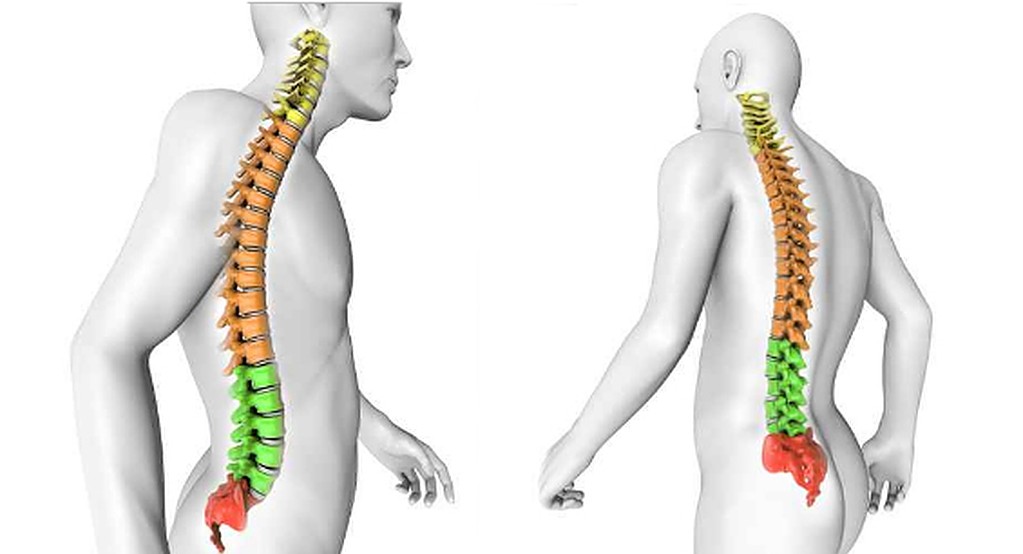
The ability to move well begins with a well-functioning foundation: the back. The spine is the basis from which movements are performed. Although a flexible back may sound like something desirable, that is only partly true.
The entire back does not need to be flexible for optimal functioning. The lower back should actually be relatively stiff, and the upper back mobile. Think of it like a slingshot. The stick must be sturdy to movement of the elastic band good to be able to transmit. The lower back is that stick. A wobbly stick cannot transmit forces, just as you cannot push a limp fire hose forward.
We often try to keep the entire back flexible and mobile. Back problems then often arise because the body attempts to create stiffness somewhere in the back. If this occurs in a place that should actually be mobile, the entire structural organization can become disrupted, which can result in various movement-related complaints, including further up the body.
A stable joint that remains stable ensures an optimal range of motion of the mobile joint connected to it. In the image below, you can see how the mobile and stable parts should alternate. One part stable, the next mobile:
How do you achieve core stiffness?
The lower back should therefore be relatively stiff so that the upper back can be mobile. How do you ensure this? By keeping the 'tent lines' taut. If you view the lower part of the spine (lumbosacral) as a tent pole that needs to stay upright, then the muscles surrounding it are the tent lines. To keep the tent pole upright, the lines on each side must be equally taut.
If we use the muscles around the torso disproportionately (for example, by only training the abdominal muscles or holding in the stomach during training), then standing upright on the duration logically, problems arise. You can build core stiffness by training the muscles surrounding the torso evenly. So, not just crunches and push-ups, but also side planks and exercises to strengthen the back muscles, such as deadlifts and bent-over rows. A powerful, short exhalation (bracing) just before exertion can maintain core stiffness and help increase it during any exercise.
Breathing
Whether or not you plan to do core stiffness exercises, you can always train your posture and bodily function with your breathing. Breathing should be directed towards the abdomen. When you maintain proper abdominal breathing, you automatically create core stiffness, both at rest and during exertion. Due to the pressure that breathing exerts from within on the core muscles and the diaphragm, tension is also created on the 'tent lines', which benefits core stiffness.
Proper breathing is a prerequisite for a well-functioning spine and, therefore, a well-functioning musculoskeletal system.
Source: www.chivo.nl


 English
  Dutch
Dutch